
Expeditions: Viking is a new play by the independent Danish studio Logic Artists, which released the first game in 2013 in its Expeditions series. Earlier, we were dealing with concutators, and today we are close to the developers themselves, in Denmark and the neighboring UK, which are the two biggest areas where this campaign is divided.
That is how you will begin in Denmark where a son of a deceased warrior and leader of his Viking clan take over the leadership and decides which direction to evolve. Development involves positioning other Danes on the Danube and ways to later drive the UK expedition as a remote country that provides many opportunities, both for potential new culture and alliances, as well as for wars and looting – the matter will depend on you.
Expeditions: Viking is similarly made up of the premise that your clan is in the break-in time of the old leader’s death, the potential weakening of relationships that are being reconfigured, and so it is necessary to act and occupy a new position in the world. This is the initial stimulus of the game to action and what moves it from within.
In this environment, there is no “great evil” or “big event” in the background that would drive the act toward itself, but the story is the world, the actors in it, and your taking positions toward those actors. Likewise, neither your character is predetermined as “the chosen one”, whose pathos decides in advance for events. However, he is still a driver in the sense of being in a position of decision making and making decisions and demands. All in all, this is the structural story of Expeditions: Viking is very similar to the first Fallout, and there is a reason for the success of these games in the reconciliation of openness / research and a certain minimal narrative that manages to keep the game from being an ordinary sandbox.
„Structurally speaking, the story of Expeditions: Viking is very similar to the first Fallout and there may be a reason for the success of these games in the reconciliation of openness / research and a certain minimal narrative that manages to keep the game from being an ordinary sandbox“
In this context, the relationship between the main-side and the side-quest in Viking is very fluent and it could even be said that the main quest is something like an integrative context for side-quarters that already tells the story of water itself in its disapproval. Expeditions: Viking is a very successful game in this aspect, just as Expeditions: Conquistador.
Since it is already clear from the premises that the essence of this game research is, the fundamental question is how it is resolved. The thing here is a little less well than the general story desig
First of all, the sense of strangeness of the new world for me was much smaller than in Conquistador. Perhaps this is subjective, given that the historical and cultural environment of Northern Europe is closer and more familiar to Indian culture in Central America at the time of the initial visits of Europeans to these regions. The Viking did not wake me in this wonder and wonder of research in the new world. This is a necessary potential trap of setting that intentionally avoids fantasy elements and even claims to a certain dose of historical accuracy.
A more objective reason for this difference is probably the fact that the main “macro” level of research on the overland map in Conquistador is richer and more detailed, with more semi-random events that simulate the disadvantages that you may encounter in an unfriendly and unknown environment. Additionally, the Conquistador system has made it easy for you to do this on a map of camping after a certain number of movements, which at higher levels of difficulty often led to the need for careful resource management, as well as to the need for attention around the type of
terrain you camp, the vicinity of the road Depends on the safety of the camp, the presence of animals your scouts can hunt for food and the like.
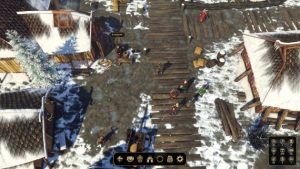
The overland map in Viking is now a 2D map, much more used as a transition system between individual locations displayed in a very classical way of 3D isometric presentation, like games like Wasteland 2 or Divinity: Original Sin. This does not mean that there is no research here on the overland map, but only that it is very simplified compared to the Conquistador.
Additionally, you will not be forced to camp after a certain amount of landslide, which entails a much smaller amount of resource management. Camping in Viking is also less challenging. First of all, the game forces you very little to camp, which will only be necessary if someone in your company gets hurt if someone in your company gets a “fatigued” status or if you need to fix some item quickly and do not go to a blacksmith who will do it for you.
All of these are circumstances that will rarely happen. Additionally, although Viking has a system that, considering the geographic location of the campsite (which is now predestined on a map location – you can no longer camp anywhere in Conquistador) variables such as security, food, etc., all these mechanisms are simpler and More than what was the case in Conquistador. In connection with this, it should be mentioned that in Viking, the possibility of choosing ironman – a fashion that does not allow repetition of lost battles and reload in the event of a member of your company’s loss or disapproval of the outcome of your election – has been ruled out. In Conquistador, this fashion has exquisitely mechanically strengthened the basic idea of the game to explore a new, dangerous and unpredictable world. Unfortunately, in Viking this is no longer the case.
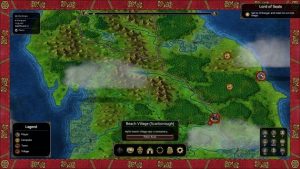
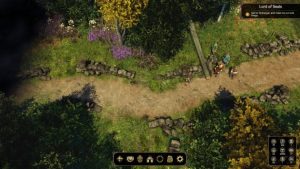
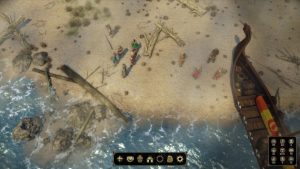
But the absence of this complicated research into the overland maps is not necessarily a shortage, but just a change in the focus of the game, as in the Expeditions: Viking most of the games (including research) take place in the locations presented in the classic 3D isometric maps where the battle is concerned. It is unfortunate, however, that in this fashion, research
has not been aroused either. Namely, although the maps are of a solid size and geographically well designed, the research on them works comparable to the first Baldur’s Gate game. These are relatively large areas with little real interest in them. This does not mean that the folders are empty, but you will encounter large amounts of very frequent and grounded items (such as crafting materials), as well as numerous interactions with characters that are mostly small and relatively inexhaustible and invulnerable.
Nevertheless, research is ultimately profitable and there are always reasons to do side-quests, as in most cases you will eventually be rewarded with some great hand-placed item. This, however, is not a game that relies on design elements like random drops of items and grinding.
The quests themselves are always centered around the characters in the world, their lives and the lives of communities in which they live. They are organically associated with setting and are almost exclusively ground floor and “realistic”. It is both good and bad at the same time – well because it is consistent with other mechanics and basic settings of the game, and badly because there is not enough room for various narrative awards or surprises in that frame. In any case, players with enough high fantasy RPGs will be the right refreshment.
The general narrative framework of the game and these set of quests sets the stage for one of the strongest sides of the Expeditions: Viking, which is the function of choice and consequence. More or less every quest I encountered allowed at least three very different ways to get rid of it. Different ways to solve them here are far from just cosmetics that some developers of recent RPGs have been trying to sell in real life in recent years.
The quality of the text itself is less inspired than the previous Expeditions game. The existence of descriptive text in most situations is always good, as it successfully puts the situation and places you in the specific positions you are in. However, dialogues themselves are relatively often too long for their content. This is no objection to someone who does not like text in games, but is an objection to the content ratio in dialogs and the amount of dialogue itself. Too subtle or overwhelming, sometimes banal content written in a larger amount of text always tends to be tedious and Viking sometimes suffers from this problem.
In addition, as someone who is a bit of a veteran in this type of game, almost all content in the game was extremely predictable. I can not get rid of the impression that in this part of the game with the development team there was simply not enough inspiration. But, in spite of this, I must mention here that the quality of the text is not bad, but it is simply not the level at which it could be.
Viking’s strength and defect ratio is determined by its fundamental design. The highly successful design of open and well-integrated stories and side-quests and the great freedom of playing the characters you want to play as well as the excellent reactivity of the game play style necessarily carry a less defined and relatively inexhaustible storyline and quests that sometimes limit the banality.
But the Viking line is surely in the shaping of the new world with its free acting within it, and therefore, despite its braves, this is a very successful game that will undoubtedly satisfy players who are looking for classic RPGs. When everything is summed up and subjugated, I have to say that I was with Expeditions: The Viking spent tens of hours in which I had a lot of fun without exception.

About The Author